
No products in the cart.



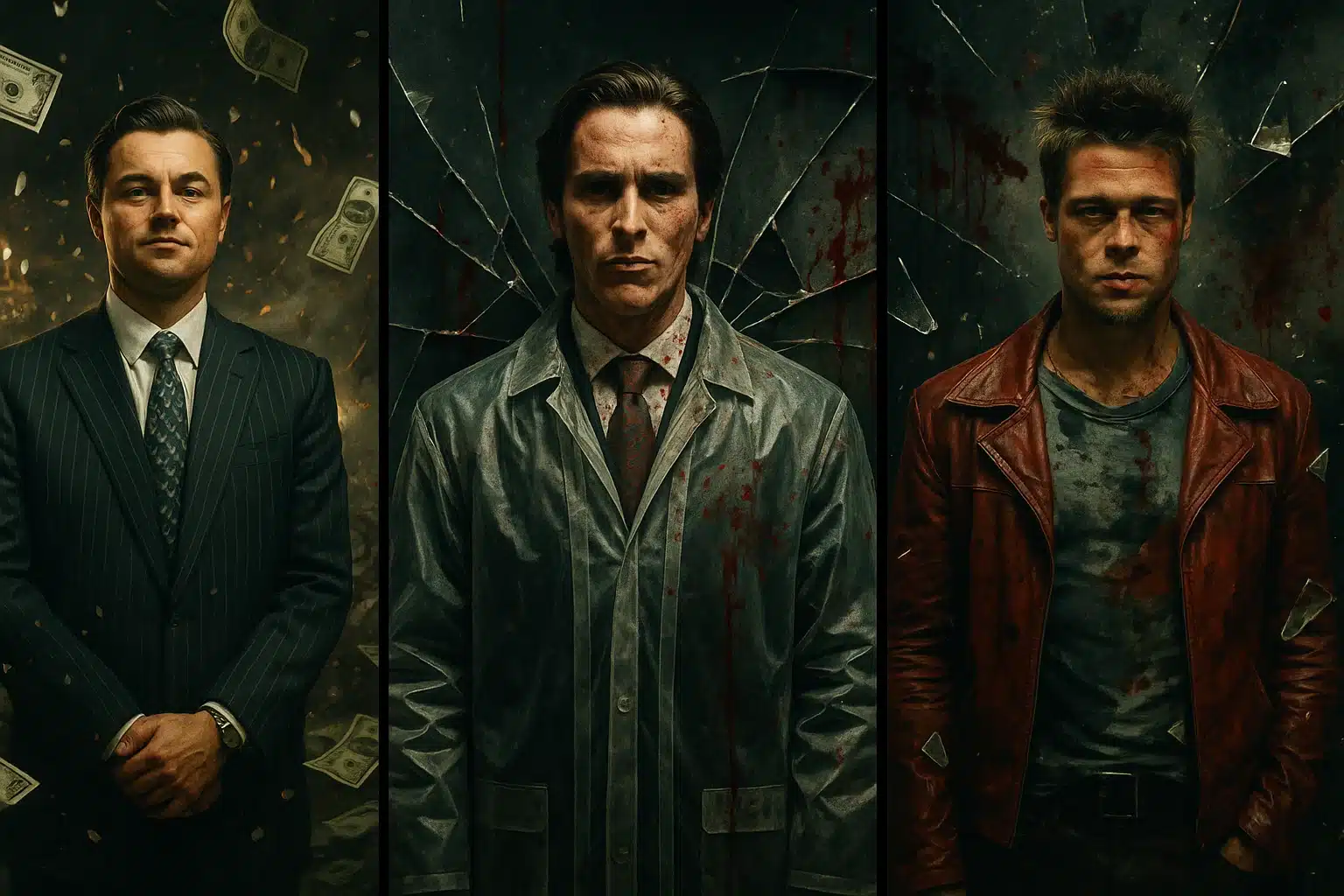
Some of the most powerful movies ever made were never trying to inspire anyone. They were trying to warn us.
But here’s the twist — the audience didn’t just miss the warning. They turned the red flag into a personality.
That’s the strange power of movies as political tools. They’re not just entertainment. They shape how we see money, masculinity, power, control. And when a character looks cool while falling apart, a lot of people start copying the look — but miss the breakdown.
The Wolf Was Never the Goal
The Wolf of Wall Street was chaos in a suit. It showed you greed, addiction, fraud, ego, and destruction — all delivered at 100 miles per hour with Leonardo DiCaprio flashing devilish grins the whole time.
It was a movie about how capitalism rewards the worst parts of people. It exposed the way ambition turns into obsession and how easy it is to ruin lives when the system tells you it’s normal.
But ask the average young dude about that movie, and they’ll tell you it “motivated them to get rich.”
That’s what happens when movies as political tools are taken at surface level. You end up idolizing the monster instead of watching him burn.
Patrick Bateman Was Falling Apart, Not Flexing
American Psycho is another one.
Patrick Bateman is a perfect mask. Suit, skin, smile, money. But under all of that, he’s hollow. Not cool. Not in control. Just broken and furious in a world that only rewards appearance.
It was a takedown of consumerism, toxic masculinity, and status games — but now he’s a meme in cologne ads and edit compilations.
That’s what makes movies as political tools tricky. They’re meant to reflect the sickness. But when the sickness looks sharp, people call it style.
Tyler Durden Was a Lie From the Start
Then there’s Fight Club. It hit like a bomb. Anti-corporate, anti-consumer, full of fire. But it was never telling you to throw punches to find freedom.
Tyler was never real. He was the fantasy. The delusion. He was the voice in your head that made pain feel like power because the rest of the world felt numb.
It was a story about how men become unstable under pressure, how alienation turns into destruction.
But instead of seeing the spiral, people saw a blueprint. They built clubs. They made rules. They missed the point.
Why We Keep Getting It Wrong
Because the fantasy is easy to grab. These movies show pain and collapse — but they package it in charisma, editing, quotes, and spectacle.
And for people who already feel powerless, it’s tempting to see these broken men as powerful. It feels like someone finally understands you. But what you’re seeing is the warning, not the solution.
Movies as political tools don’t always hold your hand. They trust you to look deeper. If you stop at the poster, you’re gonna walk away thinking Jordan Belfort is a genius, Bateman is the alpha male, and Tyler Durden had the answers.
They didn’t.
When we talk about movies as political tools, we have to talk about how people twist them. How warnings get turned into goals. How rage becomes aesthetic. How loneliness becomes identity.
If a movie hits you hard, ask yourself — is it calling you out, or calling you in?
Sometimes the villain isn’t the guy on screen. It’s what we project onto him.
And the movie? It was never lying. We just liked the mask better than the truth.
Read more – Movies as Political Tools: How Film Shapes Power